Embeddings & Collections
The Embeddings and Collections sections configure tuvl's vector search stack. Together they power Retrieval-Augmented Generation (RAG) inside your workflows.
| Section | Screenshot |
|---|---|
| Embeddings | 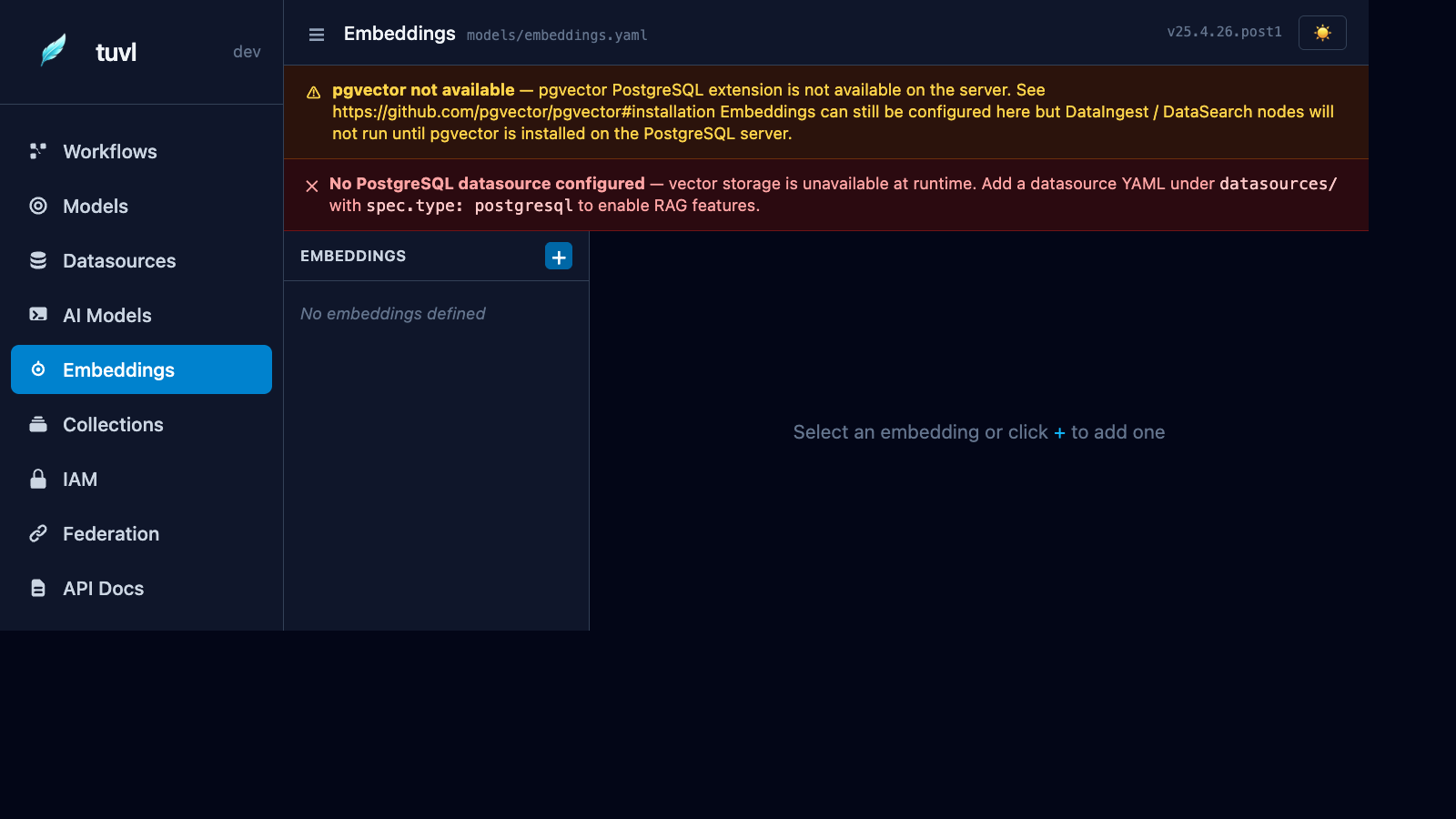 |
| Collections | 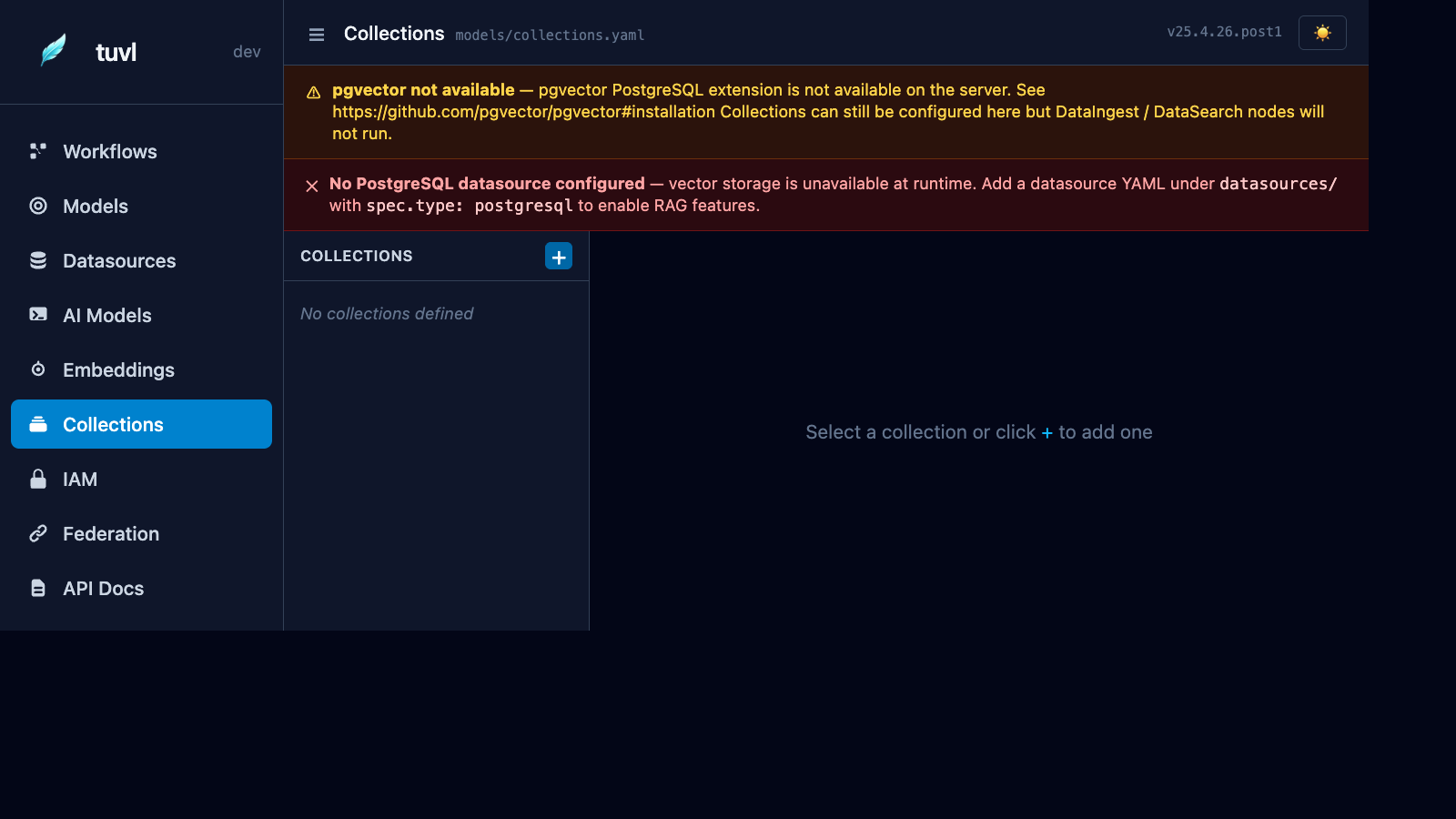 |
Concepts
Embedding model — An EmbeddingModel config defines which model converts text into a vector (e.g. nomic-embed-text via Ollama, or OpenAI's text-embedding-3-small).
Collection — A VectorCollection config defines a named pgvector table: which embedding model to use, the vector dimension, and the distance metric. Think of a collection as a searchable knowledge base.
Requirements
Both features require:
- pgvector extension — installed in your PostgreSQL database:
CREATE EXTENSION IF NOT EXISTS vector; - A connected and enabled Datasource (see Datasources).
Embeddings
EmbeddingModel YAML
kind: EmbeddingModel
version: v1
enabled: true
metadata:
  name: default_embeddings
  description: Ollama nomic-embed-text
spec:
  model: ollama/nomic-embed-text
  api_base: http://localhost:11434
dimensions: 768| Field | Description |
|---|---|
model |
LiteLLM embedding model string |
api_base |
Required for Ollama. Leave blank for cloud providers. |
dimensions |
Vector size — must match the model's output dimension |
Common embedding models
| Provider | Model string | Dimensions |
|---|---|---|
| Ollama | ollama/nomic-embed-text |
768 |
| Ollama | ollama/mxbai-embed-large |
1024 |
| OpenAI | openai/text-embedding-3-small |
1536 |
| OpenAI | openai/text-embedding-3-large |
3072 |
| Cohere | cohere/embed-english-v3.0 |
1024 |
Collections
VectorCollection YAML
kind: VectorCollection
version: v1
enabled: true
metadata:
  name: hr_knowledge_base
  description: HR policy documents and FAQs
spec:
  embedding_model: default_embeddings   # references EmbeddingModel metadata.name
  dimensions: 768
  distance_metric: cosine               # cosine | l2 | inner_product
  table: hr_documents                   # PostgreSQL table name
Distance metrics
| Metric | Use when |
|---|---|
cosine |
Most text similarity tasks (default) |
l2 |
Euclidean distance — good for dense numerical embeddings |
inner_product |
Normalised embeddings where dot product == cosine |
Using RAG in a workflow
Search and ingest are built-in code agents with typed contracts:
- id: retrieve_policy
  description: Find the relevant policy passages
  engine: code
  inputs:  { employee_question: str }
  outputs: { hits: "list[json]" }          # [{content, metadata, score}]
  code:
    run: tuvl.data_search
    with: { collection: hr_knowledge_base, query: "{{ employee_question }}", top_k: 5 }
  routes: { default: answer, error: END.failed }

- id: ingest_policy
  description: Add a policy document to the knowledge base
  engine: code
  inputs:  { title: str, content: str }
  outputs: { doc_id: uuid }
  code:
    run: tuvl.data_ingest
    with: { collection: hr_knowledge_base, document: "{{ content }}", metadata: { title: "{{ title }}" } }
  routes: { default: END, error: END.failed }
Pass hits to an llm agent as an input to ground its answer. See the knowledge-base-qa
example.